
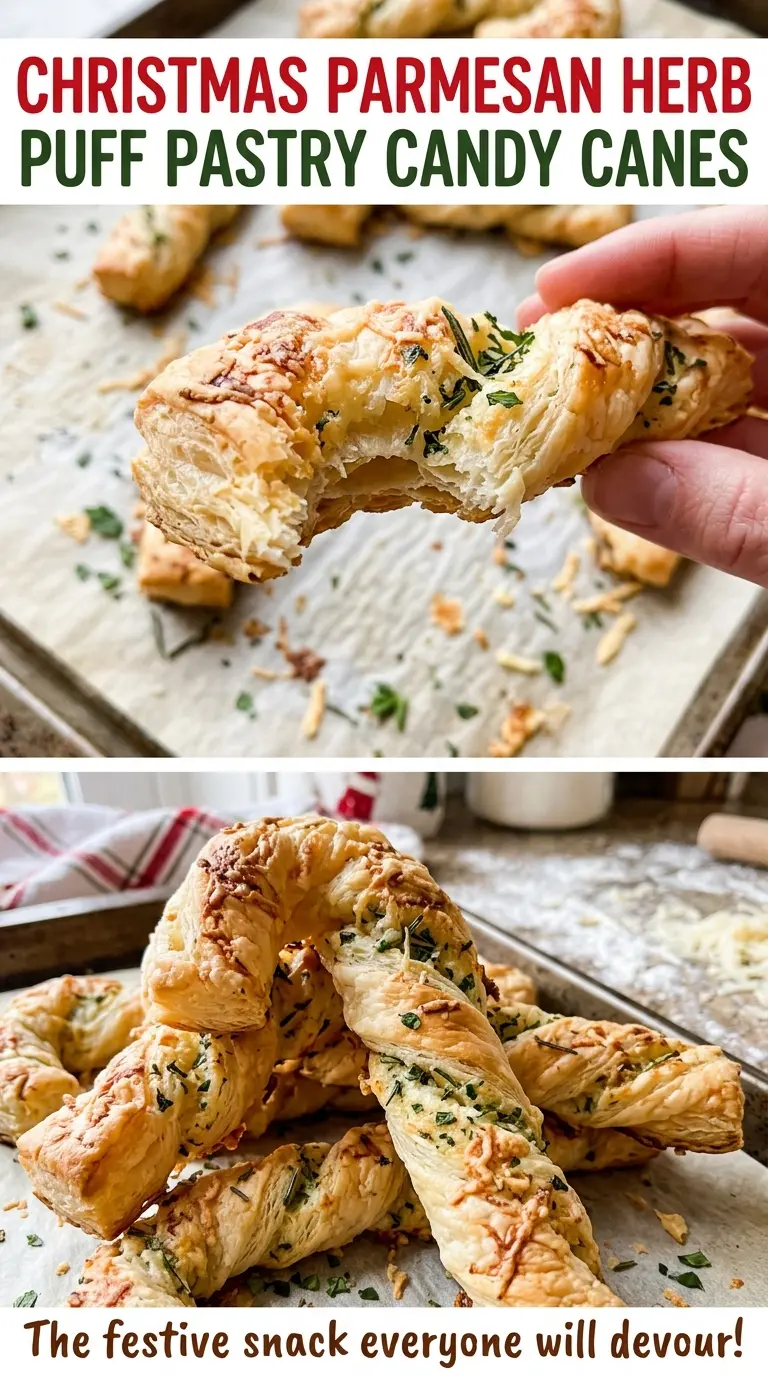
At the oven door, the pastry should be puffed and deep golden, with the candy-cane hooks still easy to recognize. Getting there depends less on elaborate shaping than on keeping the pastry cold while you work; warm strips soften and become harder to seal neatly. These Christmas Parmesan herb puff pastry candy canes make a savory, flaky appetizer with a clear shape and a filling that stays in a thin layer instead of bulging at the seams. I like that the cheese and herbs are spread across each strip, so every bite gets a little of both.
Finely grated Parmesan is easy to distribute without piling it up, and leaving a narrow border gives the egg wash room to help the pastry edges stick. Press those edges firmly together before twisting, then shape the hook without pulling the strips too tight. The baked pastry comes out crisp at the edges, tender in the center, and fragrant with parsley, rosemary, and thyme.

Kitchen Note
I twist each pair gently just 3 or 4 times, then curve the end into a hook. More twisting doesn’t make the candy cane look better; it just makes the shape harder to handle.
Save these Christmas Parmesan herb puff pastry candy canes for a savory holiday appetizer with flaky layers and a fresh herb filling.
The Thin Filling Border Is What Keeps These Candy Canes Sealed
Cheese that reaches the edge has nowhere to go when the pastry puffs. It can press against the seam and make the two layers separate, leaving little gaps where filling escapes onto the pan. A thin, even layer avoids that problem and lets the pastry rise into distinct flaky layers around the herbs.
Leave a 1/4-inch border around each filled strip, brush that bare edge with egg wash, and press the top strip down firmly. The egg wash acts as a binder between the pastry layers, while the clear border gives you a clean area to seal. If the edges aren’t pressed together, twisting can pull them apart before the pastry sets in the oven.
This is also why finely grated Parmesan works better here than a coarse shred. It spreads into a light, even layer instead of creating bulky spots that push against the seam. You want enough filling to taste the cheese and herbs, but not so much that the strips become difficult to close.
Why Finely Grated Parmesan and Fresh Herbs Make the Filling Work
- Parmesan — Finely grated cheese distributes evenly and gives the filling a salty, savory backbone. A wedge grated finely at home has a fresh, pronounced flavor; a packaged finely grated Parmesan is convenient. Skip thick shreds here because they make an even, thin layer harder to achieve.
- Parsley, rosemary, and thyme — Parsley keeps the herb mixture bright, while rosemary and thyme bring a woodsy aroma that stands up to the cheese. Fresh herbs give the filling a clean, lively taste; chop the parsley and rosemary finely so larger pieces don’t interrupt the seal. Strip the thyme leaves from their stems before measuring.
- Frozen puff pastry — The pastry provides the crisp, layered structure and is the ingredient where temperature matters most. Thaw it until pliable but keep it cold; if the sheets feel floppy or sticky, they are harder to cut and shape. Handle one sheet at a time while the other stays cold.
- Egg and water — Whisked together, they brush onto the edges to help them seal and onto the tops for a glossy, browned finish. A small pastry brush gives you more control than pouring or dabbing, especially near the hooks.
Cutting, Sealing, and Baking the Candy Cane Strips
Mix the Filling and Egg Wash
Stir the Parmesan, parsley, rosemary, thyme, garlic powder, and black pepper together in a small bowl until the herbs are distributed through the cheese. In a second small bowl, whisk the egg and water until the mixture looks uniform. Heat the oven to 400°F and line two 18×13-inch rimmed baking sheets with parchment paper. Having the filling and wash ready before cutting keeps the pastry from sitting out while you work.
Cut the Pastry and Seal the Filling Inside
Cut each pastry sheet in half across its 10 1/2-inch side, then cut each half into six strips about 1 5/8 inches wide; you’ll have 24 strips. Arrange 12 strips on your work surface and spread the filling thinly over them, leaving a 1/4-inch border. Brush the bare edges with egg wash, top each with a remaining strip, and press the edges firmly together all the way around. Keep the pastry cold as you work, and return it to the refrigerator briefly if it becomes too soft to handle.
Twist and Shape the Hooks
Gently twist each sealed pastry pair 3 or 4 times, taking care not to tug the strips apart. Curve one end of each twist into a candy cane hook. Arrange six on each prepared baking sheet, leaving space between them so the pastry has room to puff. Brush the tops with egg wash for a golden finish.
Bake Until Deep Golden Brown
Bake for 18–22 minutes, swapping the pans between racks and rotating them front to back halfway through. The candy canes are ready when the pastry is visibly puffed and deep golden brown, not merely pale blond. Let them rest on the baking sheets for 5 minutes before serving; the brief rest makes them easier to lift without crushing the flaky layers.
Two Simple Ways to Change the Shape or Cheese
Make Straight Savory Twists
Keep the filling and sealed strips the same, but leave the ends straight instead of curving them into hooks. The result is a platter of simple Parmesan-herb twists with the same crisp, flaky texture and a less seasonal look.
Trade Parmesan for Aged Asiago
Finely grate aged Asiago and use the same volume in the filling. It melts into the pastry similarly, with a slightly sharper, more pronounced cheese flavor; keep the grating fine so the strips still seal neatly.
Storage and Reheating
- Refrigerator: Store cooled candy canes in an airtight container for up to 3 days. The pastry softens as it sits.
- Freezer: Freeze baked, cooled pastries in an airtight container for up to 1 month. Their texture is best fresh, but freezing is a practical way to keep leftovers.
- Reheating: Warm them in the oven until heated through and crisp again. Skip the microwave, which softens the puff pastry rather than restoring its flaky texture.
Questions About Making Parmesan Herb Puff Pastry Candy Canes
Christmas Parmesan Herb Puff Pastry Candy Canes
Ingredients
Equipment
Method
- Heat the oven to 400°F.
- Line two 18x13-inch rimmed baking sheets with parchment paper.
- Stir together the Parmesan cheese, parsley, rosemary, thyme leaves, garlic powder, and black pepper in a small bowl.
- Whisk the egg and water in a small bowl until combined.
- Cut each pastry sheet in half across its 10 1/2-inch side, then cut each half into six strips about 1 5/8 inches wide, making 24 strips total; keep the pastry cold as you work.
- Arrange 12 strips on the work surface.
- Divide the filling among the 12 strips, spreading it thinly and leaving a 1/4-inch border.
- Brush the borders with egg wash.
- Top the filled strips with the remaining strips and press the edges firmly to seal.
- Gently twist each pastry pair 3 or 4 times.
- Curve one end of each pair into a candy cane hook.
- Place 6 candy canes on each prepared baking sheet.
- Brush the tops with egg wash.
- Bake for 18–22 minutes, swapping the pans between racks and rotating them front to back halfway through, until the pastry is puffed and deep golden brown.
- Let the candy canes rest on the baking sheets for 5 minutes before serving.
