
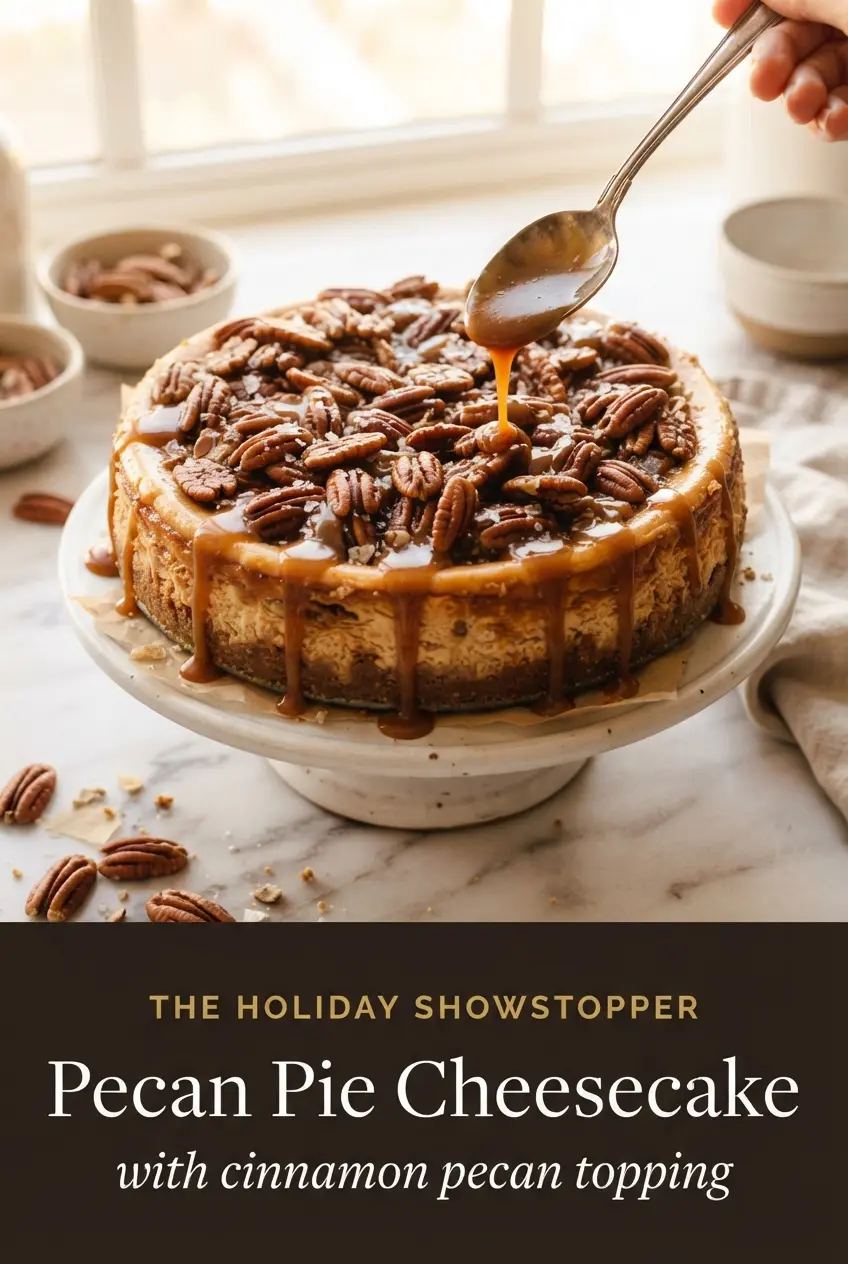
Silky cheesecake, a buttery graham-pecan crust, and a glossy pecan pie topping give you three desserts in one clean slice. The filling stays dense and smooth instead of airy, and the topping lands on top with that sticky, caramelized finish that tastes like pecan pie spooned over cheesecake. It’s the kind of dessert that gets quieter as soon as it hits the table.
The trick is treating each layer like it has its own job. The crust gets pre-baked so it stays crisp under the filling, the cheesecake bakes in a water bath so the edges don’t overcook before the center sets, and the pecan topping is cooked separately so it thickens on the stove instead of weeping all over the cheesecake. Letting the cheesecake chill completely before the topping goes on keeps the layers distinct and gives you those neat slices everyone wants.
Below, I’ve included the one cooling step that protects the texture, plus a few swaps that still keep the dessert rich and sliceable. If you’ve ever had a cheesecake crack, slump, or turn grainy, this version is built to avoid all three.
The cheesecake baked up smooth with no cracks, and the pecan topping set just enough to slice cleanly without running everywhere. I made it the day before Thanksgiving and the cinnamon-pecan layer tasted even better after chilling overnight.
Save this pecan pie cheesecake for the kind of dessert night where you want a smooth cheesecake center and a sticky cinnamon pecan topping in one slice.

The Crack-Free Center Starts with a Slow Mix and a Gentle Finish
The filling in this cheesecake should look smooth and thick before it ever goes into the oven. If you beat too much air into it, the cake rises high, then falls and cracks as it cools. That’s why the eggs go in one at a time on low speed, and the mixer stops as soon as each one disappears.
The water bath matters here too. It cushions the heat, which keeps the outer ring from overbaking while the center is still catching up. If you skip it, the edges set too fast and the cheesecake can turn dry around the rim before the middle reaches the right wobble. You’re looking for a center that still trembles in a 3-inch circle when you nudge the pan, not a firm middle.
- Cream cheese — Full-fat blocks are the only choice that give this cheesecake its dense, sliceable body. Tub-style cream cheese is softer and can make the filling loose.
- Sour cream — This adds tang and keeps the filling from tasting heavy. Room temperature sour cream blends in more cleanly, so you don’t end up with little cold lumps in the batter.
- Flour — Just enough flour helps the cheesecake set with a cleaner slice. Don’t add more than the recipe asks for or the texture starts to turn bready.
- Pecans — Use fresh pecans here. Stale nuts taste flat once they’re baked into the crust and topping, and you’ll notice it.
Building the Crust, Filling, and Topping in the Right Order
Pressing and Pre-Baking the Crust
Mix the graham crumbs, chopped pecans, brown sugar, melted butter, and salt until it clumps when squeezed. That’s the sign the butter has coated the crumbs well enough to hold together. Press it firmly into the bottom and up the sides of the pan; loose crumbs will collapse when you slice the cheesecake. The 10-minute bake sets the crust, dries out the butter a little, and keeps it crisp under the filling.
Mixing the Cheesecake Without Whipping Air Into It
Beat the cream cheese and sugar until the mixture turns smooth and glossy with no visible lumps. Scrape the bowl twice during this step because unmixed cream cheese hides at the bottom and shows up later as pockets in the baked cake. Add the eggs on low speed and stop as soon as they disappear. If the batter looks foamy, it’s already been overmixed.
Baking, Cooling, and Waiting It Out
Pour the batter into the cooled crust, set the pan in the roasting pan, and add hot water halfway up the sides. Bake until the edges are set and the center still wobbles slightly when you tap the pan. Then turn the oven off, crack the door, and leave the cheesecake inside for an hour so the temperature drops slowly. That slow cool is what keeps the top from splitting and the center from sinking.
Cooking the Pecan Topping to a Spoonable Thickness
The topping goes on only after the cheesecake has chilled all the way through. Melt the butter with the brown sugar, cream, and maple syrup, then boil it for 3 minutes without stirring so it thickens into a glossy syrup instead of a loose sauce. Once it comes off the heat, stir in the pecans, cinnamon, and vanilla, then let it cool until it mounds on a spoon. If you pour it on hot, it slides right off the cheesecake and softens the top layer.
Three Ways to Adjust the Dessert Without Losing the Texture
Gluten-Free Crust With a Clean Slice
Swap the graham crumbs for a gluten-free graham-style crumb or a gluten-free vanilla cookie crumb. Keep the pecans, sugar, and butter the same so the crust still presses and bakes into a sturdy base. The texture stays crisp and sandy, which is exactly what you want under a dense cheesecake.
No Sour Cream? Use Full-Fat Greek Yogurt
Plain full-fat Greek yogurt works in a pinch and keeps the filling tangy, though the cheesecake will be a touch less rich. Use the same amount and stir it in after the cream cheese mixture is smooth. Low-fat yogurt thins the batter and can make the center bake up less creamy.
Dairy-Free Version for the Filling
Use a high-quality dairy-free cream cheese and dairy-free butter, then swap the sour cream for a thick unsweetened coconut-based yogurt. The texture will be a little softer and the flavor slightly less tangy, but it still slices well if you chill it overnight. Don’t skip the long chill; dairy-free versions need that time to firm up.
Storage and Reheating
- Refrigerator: Keeps 4 to 5 days, covered. The topping stays sticky and the crust softens a little under the filling, but the flavor holds beautifully.
- Freezer: Freeze without the topping for the best texture. Wrap the chilled cheesecake tightly, freeze up to 1 month, thaw overnight in the refrigerator, then add the pecan topping before serving.
- Reheating: Don’t reheat the whole cheesecake. Serve it cold or let slices sit at room temperature for 20 to 30 minutes so the filling softens slightly. If the topping is very firm from the fridge, that short rest brings it back to a glossy, scoopable texture.
Questions I Get Asked About This Recipe
Pecan Pie Cheesecake with Cinnamon Pecan Topping
Ingredients
Equipment
Method
- Heat the oven to 325°F. Wrap the outside of a 9-inch springform pan in two layers of heavy foil and line the bottom with parchment.
- Stir the graham crumbs, chopped pecans, light brown sugar, melted butter, and fine salt together until the mixture holds together when squeezed.
- Press the crust firmly into the bottom and 1½ inches up the sides, then bake 10 minutes and cool 20 minutes.
- Beat the softened cream cheese and granulated sugar on medium for 3 minutes, scraping the bowl twice, until completely smooth with no lumps.
- Beat in the sour cream, then add the eggs one at a time on low speed, mixing only until each disappears to avoid adding air and causing cracks.
- Mix in the vanilla extract, all-purpose flour, and fine salt, then pour the filling over the cooled crust and smooth the top.
- Set the springform in a large roasting pan and pour hot water halfway up the sides.
- Bake for 70–80 minutes at 325°F, until the edges are set and the center 3 inches wobble slightly when you nudge the pan.
- Turn the oven off, crack the door, and leave the cheesecake inside for 1 hour so the center firms gradually.
- Cool the cheesecake to room temperature, then chill for at least 6 hours or overnight.
- Melt the butter in a saucepan over medium heat, then stir in the dark brown sugar, heavy cream, and maple syrup and bring to a gentle boil.
- Boil for 3 minutes without stirring, until thickened and glossy, then remove from heat.
- Stir in the pecan halves, ground cinnamon, and vanilla extract, then cool for 20 minutes until thick enough to mound on a spoon.
- Release the springform and spoon the pecan topping over the chilled cheesecake, letting some spill down the sides, then sprinkle with flaky sea salt.
- Chill 30 minutes before slicing with a warm knife so the layers cut cleanly.
