
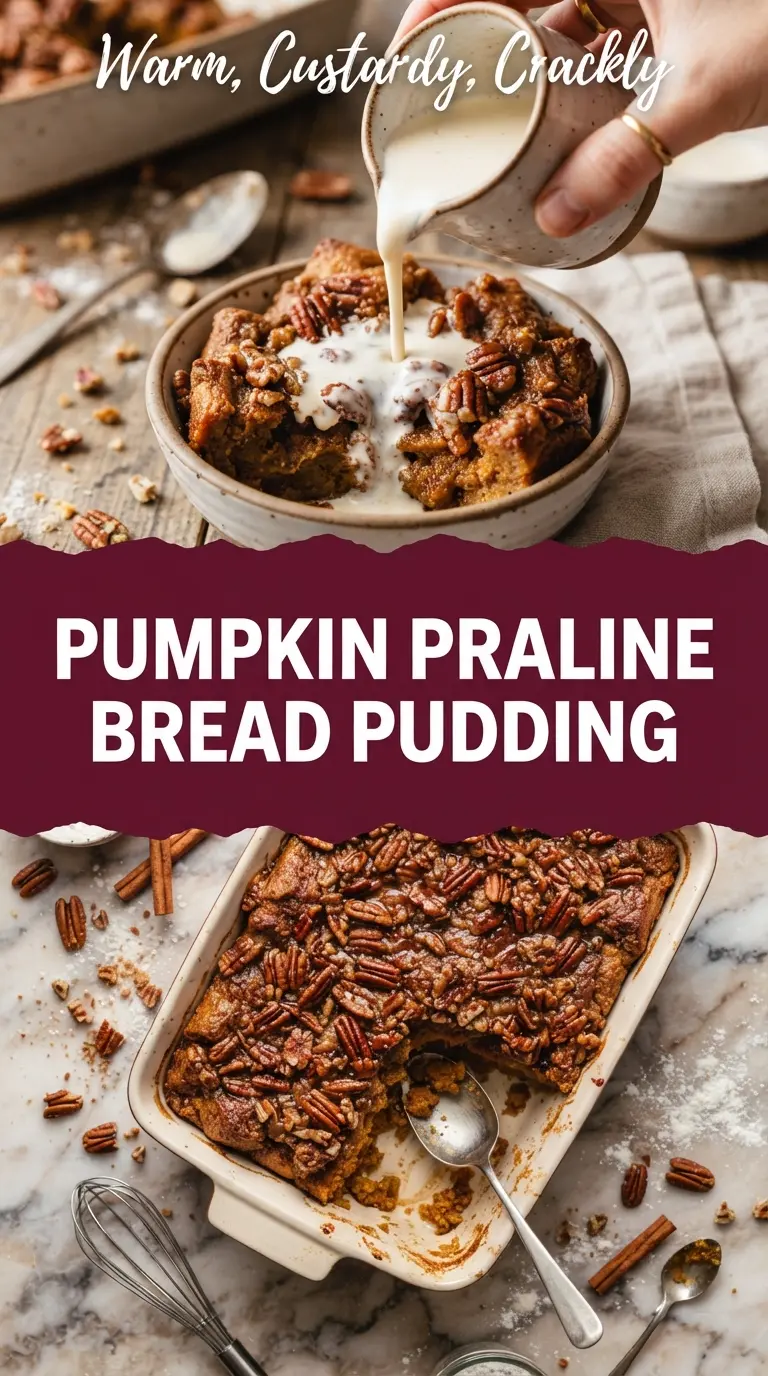
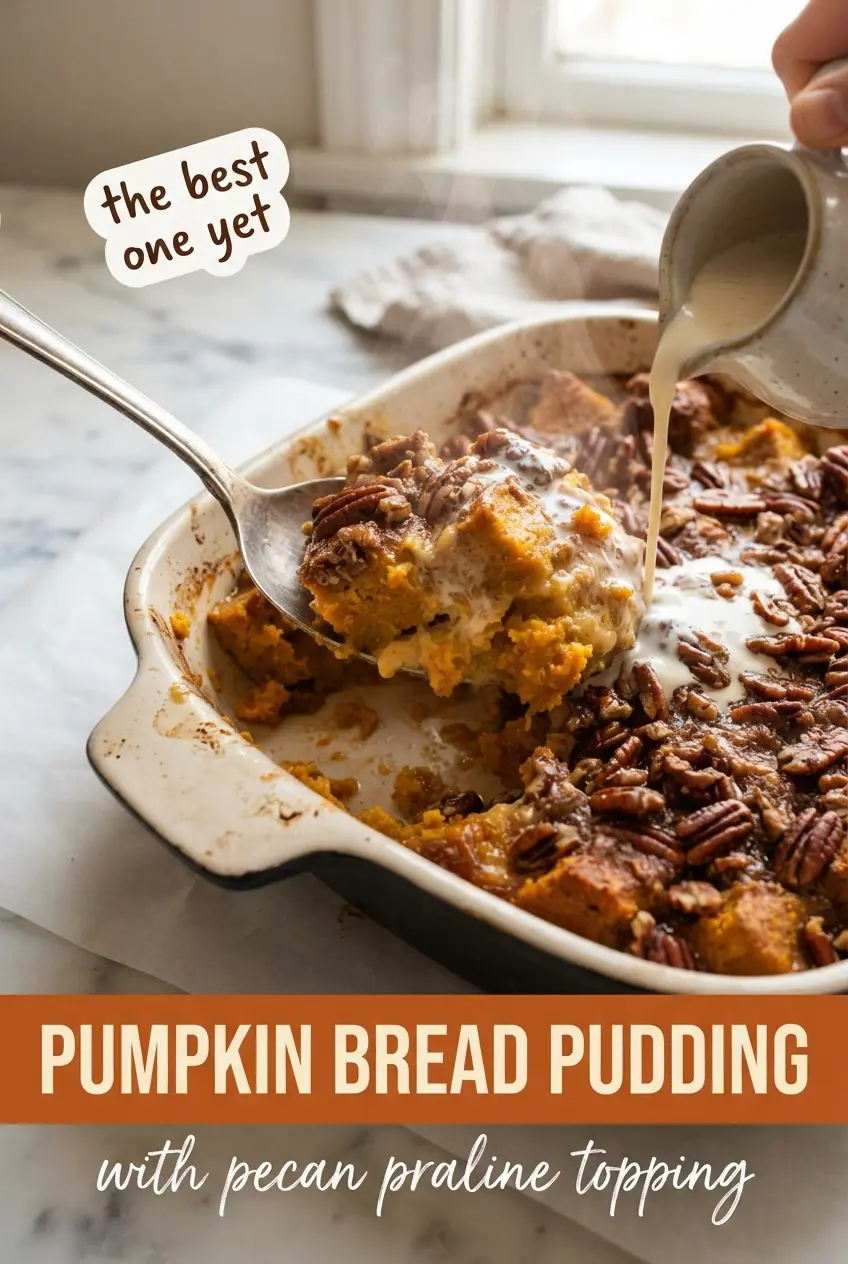
Cubes of brioche soaked in spiced pumpkin custard bake into something that lands right between bread pudding and pumpkin pie, with crisp edges, a silky center, and a praline top that cracks under the spoon. The best part is the contrast: tender, almost spoonable custard below and a brown sugar pecan crust on top that stays crisp instead of dissolving into the filling.
This version works because the bread gets a real soak before it goes into the oven. Pumpkin purée thickens the custard and gives it body, but the eggs and cream are what set it into that rich, custardy texture. The brioche or challah matters here too; a sturdy enriched bread holds its shape after soaking, so you don’t end up with a soggy pan of pumpkin mush.
Below you’ll find the small details that keep the custard smooth, the topping crunchy, and the center baked through without drying out the edges. The praline topping is worth paying attention to on its own — it bakes into those candy-like clusters that make this dish stand out.
The custard set up perfectly and the praline topping stayed crunchy even after serving. I used day-old brioche and the middle came out silky, not wet, which is exactly what I was hoping for.
Pumpkin Praline Bread Pudding has that crackly pecan topping and silky pumpkin center worth saving for the next cozy dessert night.
The Secret to Keeping the Bottom Custardy, Not Soggy
The biggest mistake with bread pudding is rushing the soak or using bread that can’t hold up. If the bread is too fresh, it collapses into paste before it ever gets a chance to bake into distinct, tender cubes. Slightly stale brioche or challah gives you structure, and the 30-minute soak lets the custard move all the way through the bread instead of sitting on top.
The other thing that matters is balance. Pumpkin purée brings moisture and density, so the custard needs enough eggs and dairy to set without turning rubbery. Bake it until the center has just a slight jiggle. If you wait until it looks completely firm in the oven, it usually comes out dry once it cools.
What Each Ingredient Is Actually Doing in This Dish
- Brioche or challah — This is the backbone of the dish. You want an enriched bread with enough structure to absorb custard without falling apart. If you only have sandwich bread, it will work in a pinch, but the pudding will be softer and less defined.
- Pumpkin purée — Use plain pumpkin purée, not pumpkin pie filling. Pie filling already contains sugar and spices, which throws off the balance and can make the custard taste muddled or overly sweet.
- Whole milk and heavy cream — The milk keeps the custard fluid enough to soak into the bread, while the cream adds richness and a softer set. You can swap in half-and-half for part of the dairy, but the final pudding won’t be quite as lush.
- Eggs — These set the custard. Without enough egg, the pudding stays loose and wet instead of slicing into spoonfuls that hold together.
- Brown sugar — Packed light brown sugar deepens the pumpkin flavor and helps the praline topping bake into a crisp, caramelized crust. Granulated sugar alone would taste flatter and less warm.
- Pecans — Chop them small enough to cling to the topping. Larger pieces taste great, but smaller bits make a better praline layer because they bind into the buttery crumbs instead of rolling off the bread.
- Butter in both parts of the recipe — Melted butter on the bread adds richness and helps the top brown. Softened butter in the topping creates those clumpy crumbs that bake into candy-like clusters instead of a dry streusel.
Building the Praline Top and Baking the Custard Through
Soaking the Bread Completely
Whisk the custard until it looks smooth and uniform, with no streaks of egg white or clumps of pumpkin. Pour it over the bread slowly, then press the cubes down so every piece gets coated. If some bread stays dry on top, those pieces will bake into tough, pale chunks instead of turning soft and custardy. Letting it sit for 30 minutes is not optional here; that soak time is what keeps the texture even.
Making the Topping Clump the Right Way
Rub the pecans, brown sugar, softened butter, flour, cinnamon, and salt together with your fingers until you get coarse crumbs with some larger bits. Those little clumps are what turn into the crackly praline layer in the oven. If the butter is too melted, the mixture turns greasy and bakes flat instead of staying pebbly on top. Scatter it evenly so the whole surface gets that candy-like finish.
Baking Until the Center Just Set
Bake at 350°F until the topping is deep golden and the center has a slight wobble when you nudge the pan. The edges will firm up first, and that is normal. If the middle still looks wet and sloshy, it needs more time; if it looks completely still, it may already be overbaked. Let it rest for 20 minutes after it comes out so the custard finishes setting without losing its softness.
Three Ways to Make This Bread Pudding Work for Your Table
Dairy-Free Version
Use full-fat coconut milk in place of the whole milk and cream, and swap in a plant-based butter for both the custard drizzle and praline topping. The flavor shifts a little toward coconut, but the pudding still bakes up rich and set. Use a neutral, unsweetened substitute so the pumpkin and spices stay in control.
Gluten-Free Bread Pudding
Replace the brioche with a sturdy gluten-free loaf that has some structure, not a soft sandwich-style bread. Gluten-free bread often breaks down faster, so aim for cubes that are a little drier before soaking. The texture will be softer and less elastic, but the custard and praline topping still carry the dessert.
Make-Ahead Brunch Casserole
Assemble the pudding up to the point of baking, cover it, and refrigerate overnight. The longer soak gives you an even more custardy center, but add the praline topping just before baking so it stays clumpy instead of dissolving into the custard. Let the dish sit at room temperature while the oven preheats so it doesn’t go into the oven ice-cold.
Swap the Pecans
Walnuts work if you want a slightly more bitter, less sweet finish, and chopped hazelnuts give the topping a deeper nutty edge. The texture stays the same as long as the nuts are chopped small enough to bind into the brown sugar crumbs. Avoid using whole nuts; they don’t form the same crisp praline layer.
Storage and Reheating
- Refrigerator: Store covered for up to 4 days. The topping softens a little, but the custard stays flavorful.
- Freezer: Freeze individual portions wrapped well for up to 2 months. The texture will be softer after thawing, but it still works if you want a quick dessert later.
- Reheating: Reheat covered in a 325°F oven until warmed through, or use short bursts in the microwave if you’re in a hurry. Don’t blast it on high heat, or the custard edges will tighten before the center warms.
Answers to the Questions Worth Asking
Pumpkin Praline Bread Pudding
Ingredients
Equipment
Method
- Butter a 9x13-inch baking dish, then spread the cubed brioche evenly inside for even soaking.
- In a large bowl, whisk the pumpkin purée, whole milk, heavy cream, eggs, brown sugar, granulated sugar, vanilla, cinnamon, ginger, nutmeg, cloves, and salt until completely smooth.
- Pour the custard slowly over the bread, then press the cubes down gently with your hands so every piece is submerged.
- Cover and let soak 30 minutes at room temperature, pressing once more halfway through, until the bread feels heavy and fully saturated.
- Heat the oven to 350°F and drizzle the melted butter over the soaked bread so it bakes up rich.
- Rub the chopped pecans, brown sugar, softened butter, flour, cinnamon, and salt together with your fingers until it forms coarse, clumpy crumbs.
- Scatter the praline mixture evenly over the top, breaking up any large clumps as you go for an even crackly layer.
- Bake 50–60 minutes at 350°F, until the topping is deep golden and crackly and the custard is puffed and set in the center with only the slightest jiggle.
- Rest 20 minutes before serving so the custard finishes setting and slices stay tidy.
- Sprinkle with flaky sea salt right before serving for a salty contrast to the sweet praline.
- Serve warm, spooning it out and pouring heavy cream over each portion so the center stays silky.
