
The first place a turkey roulade can go wrong is before it reaches the oven: warm stuffing makes a slippery filling that wants to push toward the edges. I let the sausage, apple, and bread mixture cool until it’s no longer warm, then spread it evenly inside the turkey. This sausage and apple stuffed turkey roulade with herb butter gives you the tidy slices of a rolled roast without wrestling with a whole bird.
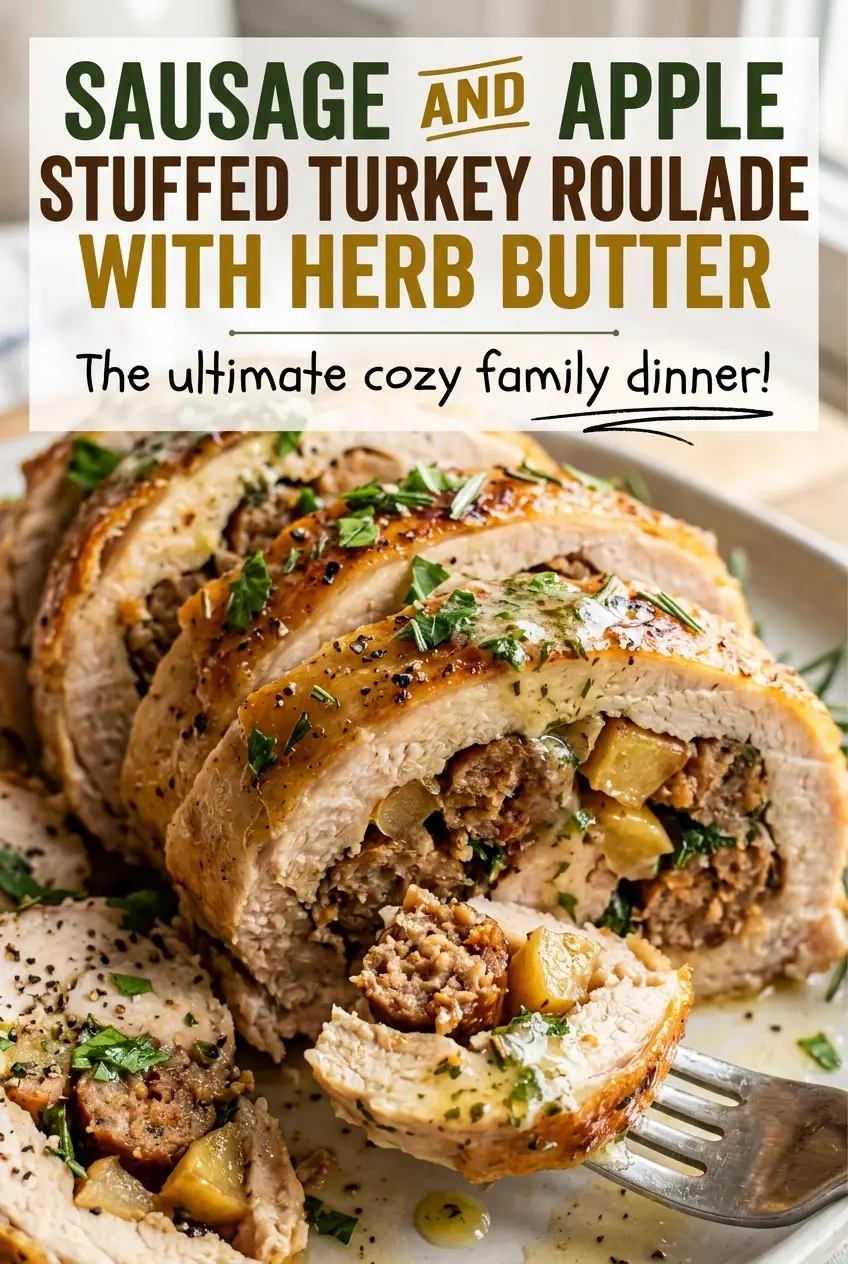
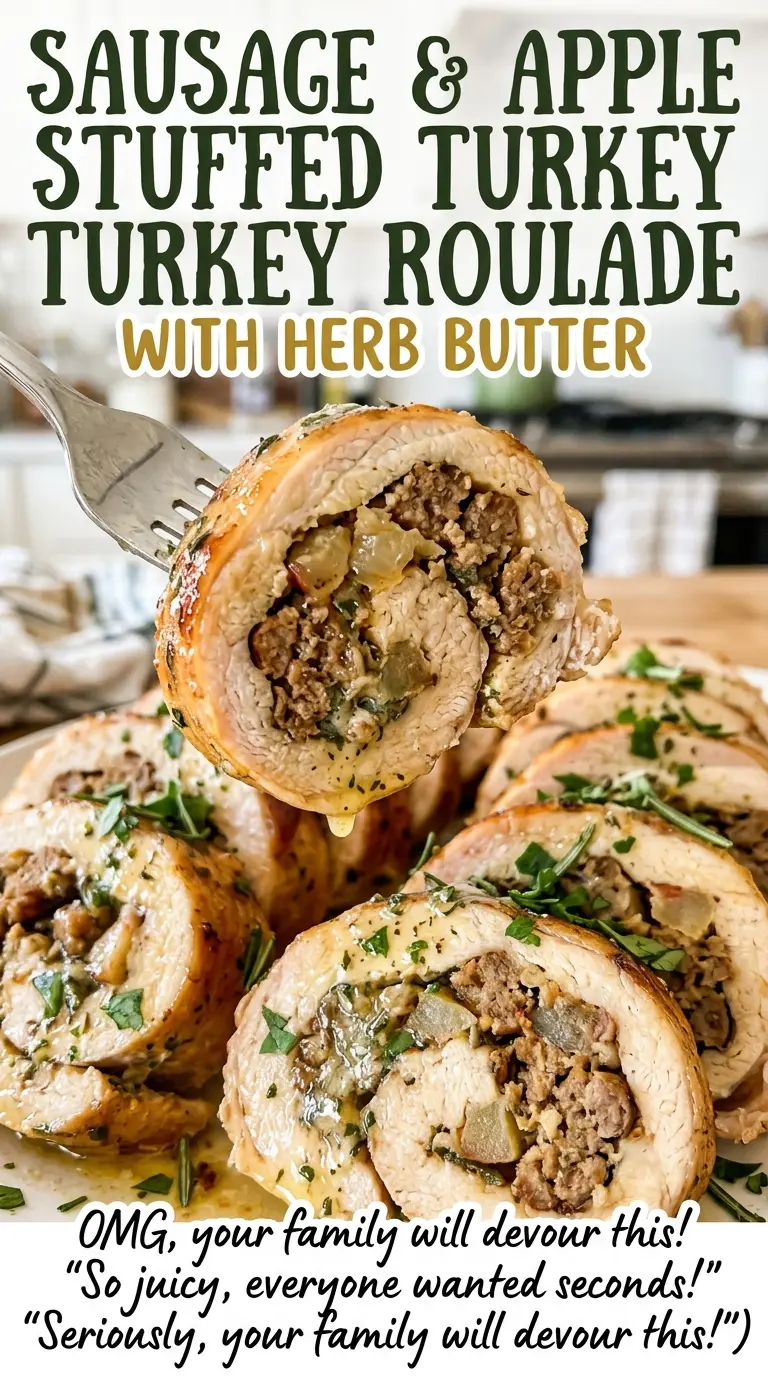
Granny Smith apple brings a tart bite alongside browned breakfast sausage, while onion and celery soften in the same skillet and pick up its savory browned bits. Pounding the turkey to an even half-inch helps it roll into a compact log instead of leaving a thick lump in the middle. Thyme, rosemary, and garlic stirred into softened butter coat the outside as it roasts. After a short rest, the slices show off a savory stuffing spiral and a buttery, herb-scented crust.
The rack lets heat move around the roulade as it roasts, and the butter turns the outside golden while the center cooks through. I use a thermometer rather than judging doneness by color, since the stuffing is tucked out of sight. Each slice is substantial enough to stand on its own, with sausage, apple, and herbs in every bite.
Kitchen Note
Use butter that’s soft enough to stir smoothly but still holds its shape. Melted butter makes the herb mixture runny, so it’s harder to spread in an even coat over the roulade.
Save this sausage and apple turkey roulade for a dinner with savory stuffing, a tart apple center, and herb butter all the way around.
A Turkey Roulade Has Two Doneness Checks, Not One
A roast can look beautifully browned on the outside and still need more time in the middle. With a roulade, the thermometer has to tell you about both the turkey and the stuffing: they’re tucked together, but they aren’t the same thing. Check the thickest part of the turkey meat, then check the center of the stuffing. The exterior color can’t confirm either reading.
The even thickness matters here, too. Pounding the breast into a consistent sheet helps avoid a thick section that lags behind the thinner edges, so the meat cooks more evenly around the filling. Don’t press the thermometer against the baking rack or stop at the first easy-to-reach spot; take a careful reading in the center of each part. Once both checks are where they need to be, the rest gives the turkey time to settle before you slice it.
Why Granny Smith and Dry Bread Cubes Suit This Stuffing
- Granny Smith apple — Its tartness keeps the sausage stuffing from tasting heavy, and the apple keeps some texture after a brief cook in the skillet. Dice it finely so it spreads through the filling instead of forming a few large pockets. A firm, tart apple is the closest stand-in; softer, sweeter fruit will make the stuffing sweeter and less distinct.
- Bulk breakfast sausage — Bulk sausage breaks into small crumbles that are easy to distribute through the bread. A plain breakfast style lets the sage and fresh herbs come through without competing with a strong seasoning blend. A bulk turkey breakfast sausage can replace the pork version for a lighter, less rich filling.
- Unseasoned dried bread cubes — Dry cubes take up the broth while holding their shape, and unseasoned ones let you control the salt and herbs. An inexpensive bag works well; the important part is that the cubes are dry and not already flavored. For a gluten-free batch, use unseasoned gluten-free dried cubes as described below.
- Unsalted butter — Unsalted butter gives you control over the seasoning in both the stuffing and the herb coating. Softened butter blends with the thyme, rosemary, and garlic without making a puddle on the turkey. If using a dairy-free adaptation, choose a firm, unsalted plant-based butter that can be softened and stirred.
- Fresh thyme and rosemary — Their aromatic, piney notes make the outside of the roast smell as good as the stuffing tastes. Chop the rosemary finely so no long, woody pieces interrupt a slice. Fresh parsley brings a lighter note to the filling; it’s fine to use an everyday bunch rather than searching for specialty herbs.
Build the Filling and Roll the Turkey Without Gaps
Brown the Sausage, Then Soften the Vegetables
Set a 12-inch skillet over medium heat and cook the sausage for 6 to 8 minutes, breaking it into small crumbles as it browns. It should reach 160°F; transfer it to a large bowl. Melt 2 tablespoons of butter in the same skillet, then cook the onion and celery for 4 to 5 minutes, until softened. Stir in the diced apple and dried sage and cook for another 2 to 3 minutes.
Moisten the Bread and Cool the Stuffing
Add the skillet mixture to the sausage along with the bread cubes, chicken broth, parsley, 1/2 teaspoon salt, and 1/4 teaspoon pepper. Toss until the cubes are evenly moistened rather than leaving dry patches at the bottom of the bowl. Transfer the mixture to a shallow dish and let it cool for 20 to 30 minutes, until it’s no longer warm. That cooling time gives you a more manageable filling when you spread it over the turkey.
Butterfly, Fill, and Tie the Breast
Heat the oven to 375°F and set a wire rack inside a 13-by-18-inch rimmed baking sheet. Cut horizontally through the thickest side of the turkey breast, stopping about 1 inch before the opposite edge; open it like a book, cover it with plastic wrap, and pound it to an even 1/2-inch thickness. Place it smooth-side down with a long edge nearest you, spread the cooled stuffing evenly over the surface while leaving a 1-inch border, then roll tightly away from you. Tie the roulade with butcher’s twine at 1 1/2-inch intervals so the roll holds its shape.
Roast, Rest, and Slice
Sprinkle the outside with the remaining 1 teaspoon salt and 1/2 teaspoon pepper, then spread the herb butter over it. Set the roulade seam-side down on the rack and roast for 60 to 80 minutes, checking at 60 minutes. It’s ready when a thermometer reads 165°F in the thickest turkey meat and in the center of the stuffing. Loosely tent with foil and rest for 15 minutes before removing the twine and slicing.
Three Practical Ways to Adapt the Stuffing
Make the stuffing gluten-free
Replace the unseasoned dried bread cubes with the same volume of unseasoned gluten-free dried bread cubes, and use a gluten-free bulk breakfast sausage. The texture may be a little softer, so toss gently and check that the cubes are evenly moistened rather than mashing them.
Make it dairy-free
Use an unsalted dairy-free butter in both portions, keeping the same division between the butter for the skillet and the softened butter for the herb coating. Choose a dairy-free bulk breakfast sausage as well. The stuffing and coating will be a little less buttery in flavor, but the roulade still rolls and roasts the same way.
Use a firm pear for a milder filling
Swap the Granny Smith for one medium firm pear, cored and finely diced, and cook it with the onion mixture for the same 2 to 3 minutes. The stuffing will taste sweeter and less tart, and a firm pear holds its shape better than a ripe, soft one.
Storage and Reheating
- Refrigerator: Refrigerate leftovers within 2 hours and keep them in an airtight container for 3 to 4 days. The stuffing softens as it sits.
- Freezer: Freeze sliced portions tightly wrapped or in a freezer-safe container for up to 2 months for the best texture. Thaw in the refrigerator before reheating.
- Reheating: Reheat slices covered in a 325°F oven until hot throughout, or use short bursts in the microwave. Keep them covered; heating the turkey uncovered for too long dries the lean meat.
Questions That Come Up When Making a Stuffed Turkey Roll
Sausage and Apple Stuffed Turkey Roulade with Herb Butter
Ingredients
Equipment
Method
- Cook the sausage in a 12-inch skillet over medium heat, breaking it into small crumbles, for 6-8 minutes, until browned and it reaches 160°F.
- Transfer the sausage to a large bowl.
- Melt 2 tablespoons butter in the skillet.
- Cook the onion and celery for 4-5 minutes until softened.
- Stir in the apple and sage and cook for 2-3 minutes.
- Stir the apple mixture into the sausage with the bread cubes, broth, parsley, 1/2 teaspoon salt, and 1/4 teaspoon pepper; toss until evenly moistened.
- Transfer the stuffing to a shallow dish and cool for 20-30 minutes until no longer warm.
- Stir the remaining 4 tablespoons softened butter with the thyme, rosemary, and garlic in a small bowl until evenly combined.
- Heat the oven to 375°F.
- Set a wire rack inside a 13x18-inch rimmed baking sheet.
- Cut horizontally through the thickest side of the turkey breast, stopping about 1 inch before the opposite edge.
- Open the turkey like a book, cover with plastic wrap, and pound to an even 1/2-inch thickness.
- Place the turkey smooth-side down with a long edge nearest you and spread the cooled stuffing evenly over it, leaving a 1-inch border.
- Roll tightly away from you and tie with butcher’s twine at 1 1/2-inch intervals.
- Sprinkle the roulade with the remaining 1 teaspoon salt and 1/2 teaspoon pepper.
- Spread the herb butter over the outside.
- Set the roulade seam-side down on the rack and roast for 60-80 minutes, checking at 60 minutes, until a thermometer reads 165°F in the thickest turkey meat and the center of the stuffing.
- Loosely tent the roulade with foil and let it rest for 15 minutes.
- Remove the twine, slice the roulade, and serve.
